

You were told you have sleep apnea, and now you have to pick a treatment. Most people want to know one thing first: do I really have to sleep with a mask?
There is no single winner here. CPAP controls sleep apnea more completely across every severity level, so doctors call it the first choice. An oral appliance is a mouth device that many people find easier to wear night after night. The better treatment is the one you will actually use. Your severity and your comfort decide it, not a ranking.
At the San Diego Sleep & TMJ Center in downtown San Diego, Dr. Nina Mojaver, DMD, has spent 25 years treating jaw and sleep-related conditions. She fits oral appliances for patients who cannot get comfortable with CPAP. This guide lays out how the two compare so you can walk into that conversation ready.
What to know before you choose
- CPAP is the most effective treatment for obstructive sleep apnea at every severity level, which is why sleep doctors usually try it first.
- Oral appliances suit mild to moderate sleep apnea, or people who cannot tolerate CPAP. They are not for severe cases on their own.
- People tend to keep wearing oral appliances more consistently than CPAP, and the treatment you stick with is the one that works.
- CPAP machines usually run $500 to $1,000. A custom oral appliance from a dentist can run several hundred to a few thousand dollars.
- Ask for a sleep study result first. Your apnea-hypopnea index score tells your dentist and doctor which option fits.
How does CPAP work?
CPAP stands for continuous positive airway pressure. A small machine pushes a steady stream of air through a hose and a mask into your airway while you sleep. That air pressure props the airway open, so it cannot collapse and interrupt your breathing. It works the same way all night, every night.
Sleep doctors call CPAP the first-line treatment for obstructive sleep apnea. The American Academy of Sleep Medicine treats it as the standard for measuring other options. It handles mild, moderate, and severe cases. It can also treat central sleep apnea, which oral appliances cannot touch.
The catch is wearing it. Some people get a dry mouth, feel boxed in by the mask, or struggle to breathe against the pressure at first. Many of those problems ease with a different mask, added humidity, or a pressure change. A CPAP machine also needs regular cleaning and replacement parts.
How does an oral appliance work?
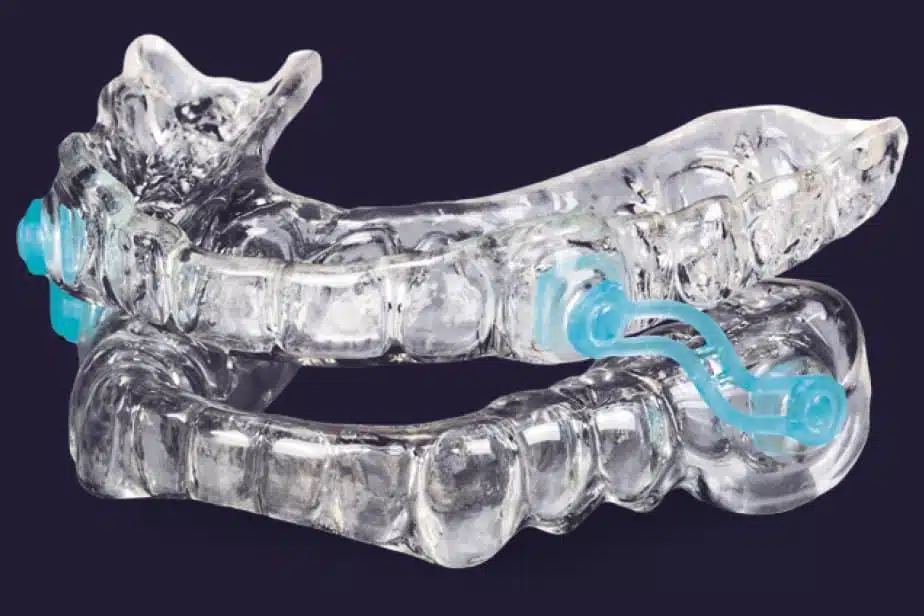
An oral appliance is a custom device you wear in your mouth during sleep, close to a sports mouthguard or a retainer. The most common kind is a mandibular advancement device. It holds your lower jaw slightly forward, which opens up space at the back of your throat and keeps the airway from collapsing.
A qualified dentist fits and adjusts the device to your mouth. The American Academy of Dental Sleep Medicine recommends a custom, adjustable appliance over a drugstore boil-and-bite version, because the fitted ones work better and cause fewer problems. Dr. Mojaver builds these for patients at the San Diego practice.
Oral appliances have their own trade-offs. Early on you might notice jaw soreness, tender teeth, extra saliva, or a dry mouth. Over a long stretch, the device can shift your bite slightly, which is why regular dental checks matter. People with too few healthy teeth or an active jaw joint problem may not be candidates.
Which one actually controls sleep apnea better?
CPAP lowers the number of breathing interruptions more than an oral appliance does, measured on the apnea-hypopnea index. A meta-analysis of 80 studies reached that conclusion. On raw clinical power, CPAP wins, especially for severe sleep apnea.
Here is the twist. Studies also show people wear oral appliances more consistently than CPAP. A treatment only works during the hours you use it. A machine sitting in a drawer treats nothing. For someone who abandons CPAP after two weeks, an oral appliance worn every night can deliver better real-world results.
So the honest answer depends on the person. Severe apnea usually needs the raw strength of CPAP. Mild to moderate apnea, or a history of quitting CPAP, tilts toward an appliance you will actually keep in.
CPAP vs. oral appliance, side by side
The table below sums up the practical differences. Bring it to your consultation.
| Factor | CPAP | Oral Appliance |
| How it works | Pumps pressurized air through a mask to hold the airway open | Holds the lower jaw forward to open the throat |
| Best for | Mild, moderate, and severe OSA, plus central sleep apnea | Mild to moderate OSA, or CPAP intolerance |
| Clinical effectiveness | Highest; the measured standard | Effective for the right patient, less so than CPAP overall |
| Consistency of use | Lower for many people | People tend to wear it more consistently |
| Comfort | Mask and pressure take adjustment | Rated more comfortable by most users |
| Travel | Bulkier, needs power | Fits in a pocket, no power needed |
| Typical cost | $500 to $1,000 | Several hundred to a few thousand for a custom device |
| Upkeep | Cleaning, filters, hoses, mask parts | Daily cleaning, periodic dental checks |
What does each option cost in San Diego?
Cost splits into the device and the follow-up. A CPAP machine usually falls between $500 and $1,000, before masks and replacement supplies. A custom oral appliance made by a dentist can run from several hundred dollars to a few thousand, depending on the device and your bite.
Insurance often helps with both. Medicare and many private plans cover CPAP when a sleep study confirms sleep apnea and you keep using the machine. Many plans also cover a custom oral appliance when a doctor documents the diagnosis and calls it medically necessary. Drugstore devices are generally not covered.
Coverage details change by plan, so confirm your own before you commit. The team at the San Diego Sleep & TMJ Center can review what your plan includes for oral appliance therapy and give you an exact figure for your case.
How do you decide between them?
Start with your sleep study. Your apnea-hypopnea index score and your sleep doctor’s read of your severity point the way. Severe sleep apnea usually means CPAP first. Mild to moderate cases open the door to an oral appliance.
Then weigh honesty about yourself. Have you tried CPAP and given up? Do you travel often, or share a bed with someone the machine keeps awake? Those are real reasons an appliance may serve you better, even if CPAP scores higher on paper. The AASM and AADSM specifically back oral appliance therapy for people who cannot tolerate CPAP or prefer another route.
You do not have to sort this out alone. A dentist trained in sleep works alongside your physician to match the option to your diagnosis and your life.
Getting fitted in San Diego
If CPAP has beaten you, or you want to know whether an oral appliance fits your case, the next step is a conversation with a dentist who does this work. Dr. Nina Mojaver, DMD, at the San Diego Sleep & TMJ Center treats jaw and sleep conditions and builds custom oral appliances for the right patients.
Bring your sleep study if you have one. To book a consultation, call the San Diego Sleep & TMJ Center at 619-657-0787. The office is on A Street in downtown San Diego and works with your physician on a plan that fits your diagnosis.